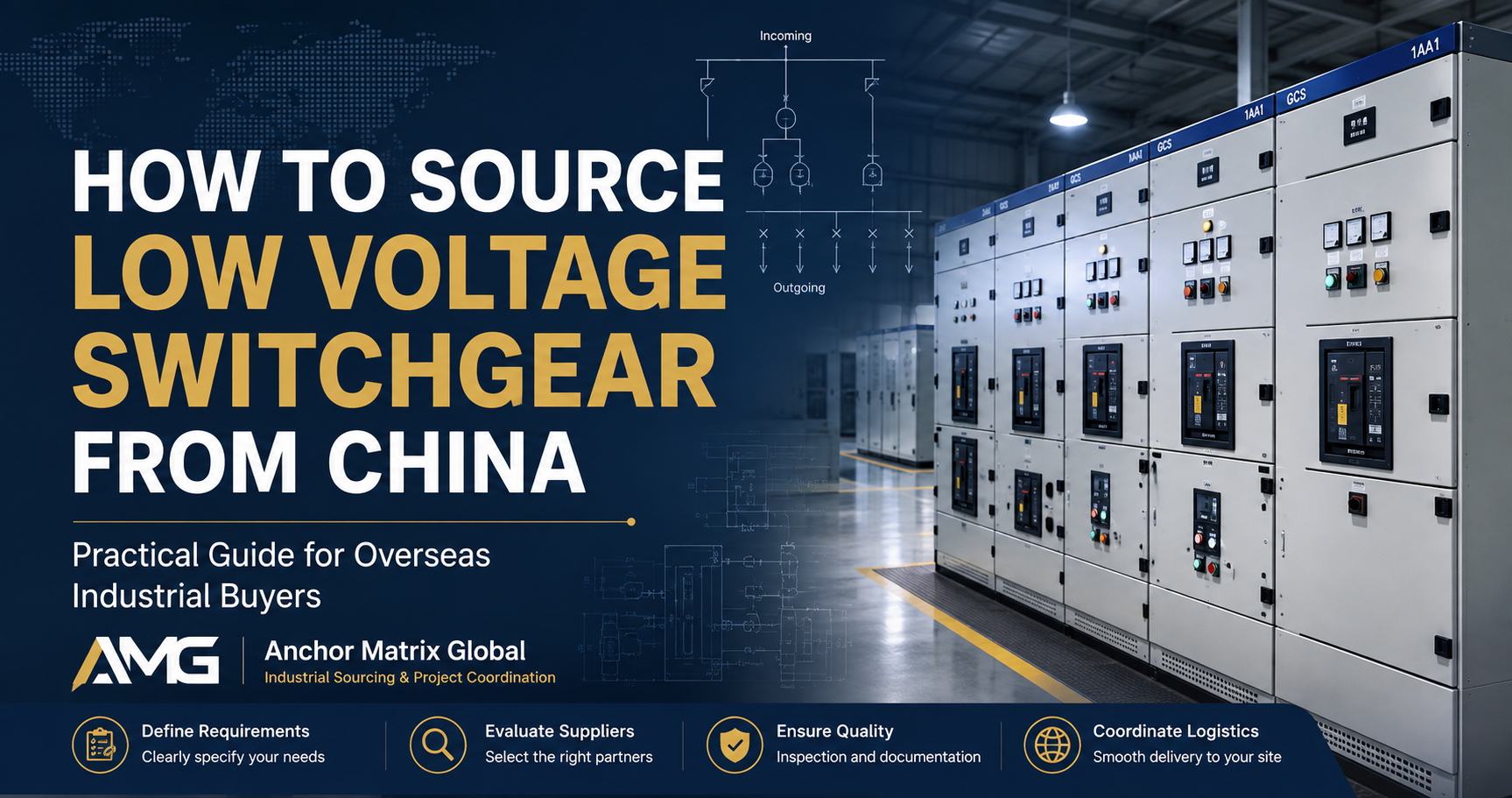
When you evaluate low voltage (LV) switchgear from China, the most important decisions usually happen before any quotation is sent. The right specification, the right supplier shortlist, and the right comparison framework typically determine whether the project runs smoothly, or whether it becomes a costly exercise in rework.
This guide walks through what an overseas industrial buyer should consider when sourcing LV switchgear from Chinese manufacturing partners. It focuses on the practical decisions you will need to make: what to define up front, how to evaluate quotations, what documentation to request, and where the typical project risks sit. The intent is to help you make more informed procurement decisions, whether you coordinate the process internally or with external support.
1. What to define before contacting suppliers
Many cross-border LV switchgear projects start with an inquiry that is too thin to quote accurately. The result is a round of clarification that delays everything. Before reaching out, it helps to define the following on paper, even if some items are preliminary:
- Project destination country — drives applicable standards, voltage and frequency, and certification requirements.
- Project type — new build, expansion of an existing facility, or replacement of installed equipment.
- Target delivery window — aligned with site construction schedule, marine handling and customs.
- Approximate quantity and cabinet count — affects whether a single shipment or staged deliveries are appropriate.
- Procurement model — one-off order, framework agreement, or recurring purchases over a defined period.
- Internal ownership — who signs off on technical clarification, who approves the supplier, who manages inspection.
None of these items is commercially sensitive. Sharing them with potential manufacturing partners at the inquiry stage reduces the risk of an inaccurate first-round quotation.
| Category | Item | Priority | Why it matters |
|---|---|---|---|
| Project identification | Destination country and applicable national standards | Critical | Drives voltage, frequency and certification requirements |
| Electrical parameters | Rated voltage, rated current, system frequency (50 Hz or 60 Hz) | Critical | Determines busbar and component sizing |
| Electrical parameters | Prospective short-circuit current at the point of installation | Critical | Determines Icw, Ipk and breaker selection |
| Drawings | Single-line diagram (functional SLD acceptable for first round) | Critical | Without an SLD, the first quotation is a guess |
| Quantity | Required cabinet quantity and approximate cabinet count | Critical | Affects pricing tiers, packaging and shipping plan |
| Mechanical | Cabinet dimensions or installation space constraints | Important | Drives enclosure sizing and busbar arrangement |
| Mechanical | Cable entry direction and busbar arrangement | Important | Drives gland plate design and access for maintenance |
| Standards | Applicable standards and certification marks required (IEC, GB, BS, UL, AS/NZS, CE, CCC, country-specific marks) | Critical | Some marks are non-negotiable and affect component selection |
| Components | Preferred component brand tier and any specific part numbers | Optional (Important when brand is specified) | Tightens scope but extends quotation cycle |
| Environment | Operating environment (indoor / outdoor, altitude, humidity, corrosive) | Important | Drives derating, IP rating and surface treatment |
| Commercial | Target delivery window and preferred Incoterm | Important | Drives factory allocation, shipping mode and risk allocation |
| Documentation | Documentation language and document set required with delivery | Important | English documentation is typically an extra; specify at inquiry to avoid rework |
| Inspection | Inspection regime (buyer witness, third-party, document review or PSI) | Important | Should be agreed at contract stage, not at delivery |
Priority assumes a typical overseas industrial project; actual priority depends on project complexity, destination country, applicable standards and the procurement model (one-off order, framework agreement or recurring purchases). For a sequential operational checklist of items to send with the RFQ, see section 16.
2. Voltage, current, frequency and short-circuit requirements
Low voltage switchgear in industrial projects is most commonly built for 400 V, 480 V or 690 V operation, at 50 Hz or 60 Hz. The rated current of the main busbar, the rated current of outgoing feeders, and the prospective short-circuit current at the point of installation together determine the sizing of the assembly.
A few details that are easy to overlook but matter in practice:
- Frequency — 50 Hz and 60 Hz components are not always interchangeable, particularly for certain transformer and magnetic designs. If your project is in a 60 Hz country, that needs to be stated explicitly in the inquiry.
- Short-circuit withstand — expressed as Icw (short-time withstand current) and Ipk (peak withstand current). The values depend on the upstream transformer and the impedance of the system; they are not chosen by the switchgear supplier.
- System earthing — TN-S, TN-C-S, IT, TT and similar arrangements affect how the neutral is treated, where RCDs or insulation monitoring are required, and how the assembly is built.
- Altitude and ambient — installations above 1,000 m altitude, in high humidity, or in corrosive atmospheres require derating or special surface treatment.
These are the technical inputs a manufacturing partner needs before they can produce a meaningful first quotation.
What voltage range counts as "low voltage" in industrial projects?
In industrial electrical distribution, low voltage (LV) most commonly refers to assemblies operating at 400 V, 480 V or 690 V. Medium voltage (MV) typically starts at 3.3 kV and runs up to 36 kV or 40.5 kV, depending on the country and the local utility. Where the line is drawn exactly depends on national practice, the local distribution company and the applicable standard — not on a single global rule.
| Aspect | Low voltage (LV) | Medium voltage (MV) |
|---|---|---|
| Typical voltage range | 400 V, 480 V or 690 V | 3.3 kV, 6.6 kV, 10 kV, 11 kV, 24 kV, 33 kV or 40.5 kV (depends on project) |
| Governing standard family | IEC 61439 (with regional equivalents such as GB 7251, BS EN 61439, UL 891, AS/NZS 61439) | IEC 62271 (with regional equivalents such as GB/T 11022, IEEE C37, BS EN 62271) |
| Common assembly type | Power switchgear, distribution boards, motor control centres | Switchgear panels, ring main units (RMUs), circuit breakers, transformer interfaces |
| Typical configuration families | GGD, GCS, GCK, MNS, XL-21 (industry-standard designations; see section 4) | KYN28, KYN61, XGN, HXGN, DFW and similar (varies by manufacturer and application) |
| Typical buyer role | End user, EPC contractor, panel builder | Utility, large industrial facility, EPC contractor |
| Typical shipping profile | Cabinets and panels, often containerised | Panels and equipment rooms, often shipped as project cargo |
Voltage classifications and standard families vary by country and project context. Confirm the applicable range and standard with the relevant utility, consultant and selected standard before writing the inquiry. Where both LV and MV scope are required, see medium voltage switchgear alongside the LV scope.
3. Single-line diagram (SLD) and technical specifications
The single-line diagram is the most efficient way to communicate the electrical topology of the switchgear to a manufacturer. For a first inquiry, a functional SLD is usually enough: it shows the incoming section, busbar, outgoing feeders, breaker ratings, and the location of metering and protection devices.
What a useful first-round SLD typically contains:
- Rated busbar current, number of poles, neutral treatment.
- Incoming circuit breaker or disconnect, with rated current and short-circuit rating.
- Outgoing feeders, each with breaker rating, function (motor, feeder, lighting) and load details.
- Current transformers, voltage transformers and metering points.
- Protection zones and any interlocking between sections.
Where available, also send the layout drawing (room dimensions, cable entry direction, front/back access) and a rough BOM with major component preferences. Drawings do not need to be finalised at this stage; they need only be sufficient for a first-round quotation.
4. Common LV switchgear configurations
Chinese manufacturers typically offer several well-known configuration families. The names below are industry-standard designations commonly used in specifications, datasheets and quotation documents; they are not brand names.
- GGD — fixed-type LV switchgear, typically used in basic power distribution. Lower cost, simpler maintenance, less flexible for future changes.
- GCS — withdrawable LV switchgear, modular design, widely used in motor control and distribution applications where individual compartments may need to be isolated without full shutdown.
- GCK — withdrawable LV switchgear, similar in concept to GCS, with a focus on motor control centres.
- MNS — modular withdrawable LV switchgear, derived from a design originally licensed by ABB. Used in larger industrial and infrastructure projects where standardization matters.
- XL-21 — power distribution cabinet (non-modular), common in smaller distribution rooms and branch distribution. See related distribution cabinet options.
Selection is usually driven by three questions: do you need withdrawable compartments for operational flexibility, how critical is future expansion, and what maintenance philosophy does your facility follow? The configuration family is a project-level decision, not a per-cabinet decision.
5. Component brands and substitution considerations
Most Chinese LV switchgear manufacturers are accustomed to building assemblies with specified international component brands — Schneider, ABB, Siemens, Eaton and similar. The choice of brand has direct cost, lead time and certification implications, and should be made consciously rather than left implicit.
Three rules of thumb that help in practice:
- Specify part numbers, not just brand names. "Schneider" is not a specification; "Schneider NSX 250F 3P Micrologic 2.2" is. Without a part number, the manufacturer can substitute within the brand family, sometimes in ways that affect functionality.
- Treat "or equivalent" as a contract term, not a phrase. If you allow substitution, define what "equivalent" means: same breaking capacity, same trip unit, same dimensions, same approvals. Otherwise substitution becomes a frequent source of dispute.
- Be aware of brand categories. International premium brands sit at the top of cost and lead time. Mainstream international brands and major Chinese brands (LS, Chint, Delixi and others) offer different price points and country-specific certifications. The category choice is a project decision.
If you have a strong brand preference, state it at the inquiry stage. If you do not, ask the manufacturer to propose an option and explain the trade-off.
6. Standards, certifications and required documentation
Low voltage switchgear and controlgear assemblies are governed by IEC 61439, with regional equivalents in most markets. Knowing which standard applies to your project is non-negotiable; it determines the design rules the manufacturer must follow and the test records you can request.
Common standard families to be aware of:
- IEC 61439 — international standard for LV switchgear and controlgear assemblies, with sub-parts covering power switchgear (Part 2), distribution boards (Part 3), construction sites (Part 4) and similar applications.
- GB 7251 — Chinese national standard, technically aligned with the IEC 61439 series.
- BS EN 61439 — UK and EU adoption of IEC 61439.
- UL 891 — North American standard for LV switchgear; the design rules and component choices differ from IEC.
- AS/NZS 61439 — Australia and New Zealand adoption.
Two test concepts are often confused and worth distinguishing:
- Type test (design verification) — performed on a representative assembly to confirm that the design meets the standard. The report applies to a design family, not to a specific unit.
- Routine verification (individual series test) — performed on every delivered unit, to confirm that the as-built assembly is consistent with the design. Buyers should always require routine verification records with delivery.
Country-specific certification marks (CE for the EU, CCC for China, UL or cUL for North America, country-specific marks for the Middle East) must also be confirmed in advance, as they affect component selection and the manufacturing workflow.
7. Customization requirements to clarify early
Most LV switchgear projects involve some degree of customization. The cost and lead time impact of customization is usually larger than buyers expect, so the scope should be defined explicitly before quotation, not at the drawing approval stage.
Items that frequently drive customization:
- Cabinet dimensions and room restrictions — ceiling height, cable room depth, door swing direction, access for replacement.
- Cable entry direction — top, bottom, side, or a combination. Determines the gland plate design.
- Busbar arrangement — top, rear or front access; this affects both footprint and future maintainability.
- Special environments — marine, chemical, high altitude, outdoor. Each has implications for surface treatment, IP rating and component selection.
- Aesthetic or labelling requirements — colour scheme, nameplate language, warning signs.
- Future expansion — spare compartments, spare ways, planned load growth.
Customization that is not defined at the inquiry stage is almost always more expensive than customization that is defined at the inquiry stage.
8. Evaluating factories and suppliers
Not every Chinese LV switchgear factory is a fit for every project. The evaluation should focus less on the size of the factory and more on the match between the project's requirements and the manufacturer's capabilities. A useful shortlist combines the following checks:
- Relevant manufacturing capability — does the factory regularly build the configuration family and the component brand tier your project requires?
- Engineering capability — can their technical team read your SLD, ask sensible questions, and propose alternatives when specifications are unclear?
- Reference projects — projects of similar scale, similar standards and similar application, ideally in a destination country you can verify. Examples of the industrial sectors most commonly served by LV switchgear projects include manufacturing facilities, commercial buildings, infrastructure and energy projects.
- Quality management — a documented quality system is a baseline expectation; the depth of the quality system matters more than its certification mark.
- Communication quality — responsiveness, clarity of written English, willingness to put commitments in writing. These are early indicators of how the project will run.
- Capacity availability — the manufacturer's current load relative to your required delivery window.
Where possible, a factory visit or a recorded video walk-through adds confidence. Where travel is not practical, third-party audit reports (for example from inspection bodies familiar with the electrical industry) can substitute for part of the evaluation.
9. Comparing quotations: why the lowest price is not enough
Two quotations that look similar in unit price can differ by a wide margin in delivered value. A meaningful comparison breaks each quotation down by scope.
Items that are frequently omitted from the cheapest quotation and recovered later as extras:
- Main busbar current rating and the inclusion of busbar supports.
- Component brand and exact part numbers for breakers, contactors, relays and meters.
- Spare parts (commonly 2–5% of components, depending on the project).
- Type test certificates and routine verification reports.
- Documentation language and completeness (English documentation costs more than the default).
- Packaging specification suitable for export, including moisture control and reinforcement.
- Delivery terms — the Incoterms (EXW, FOB, CIF, DAP, DDP) change the buyer's cost and risk profile materially.
- Payment terms and any tooling or mould costs.
- Warranty period and what it explicitly covers.
The right way to compare quotations is to align scope first (often by sending a clarification round) and then compare the resulting prices. A quotation that looks 15% cheaper but excludes routine verification, packaging and English documentation is rarely the better deal once those items are added back.
How should two quotations be compared fairly?
Build a single comparison sheet before looking at prices. The sheet should list every scope item on the same row — busbar rating, breaker part numbers, spare-parts allowance, type test and routine verification reports, packaging specification, documentation language, delivery terms, payment terms, warranty and after-sales scope — and confirm with each supplier that the line is included, excluded or to be clarified. Only when the scope columns match should the price column be compared. Two quotations with different scope are not directly comparable, no matter how close the headline number appears.
10. Production confirmation and technical approval
Once a supplier is selected, the technical approval process is where most project misunderstandings are either prevented or created. A clear approval workflow — agreed in advance and documented in writing — protects both sides.
A typical approval sequence for LV switchgear:
- General arrangement (GA) drawing approval — overall dimensions, compartment layout, cable entry positions.
- Schematic diagram approval — control and protection logic, terminal numbering, relay settings.
- Terminal diagram and wiring list approval — for cabinets with significant control wiring.
- BOM freeze — final component list, with part numbers and quantities.
Each approval stage should be closed with a written sign-off, an approval date, and a clear statement that subsequent changes go through a formal change-management process. Verbal approvals and "we can change that later" are a common source of disputes.
11. FAT and inspection considerations
Factory Acceptance Testing (FAT) is the buyer's opportunity to confirm, before shipment, that the assemblies match the approved drawings and function as expected. FAT can be done by the buyer's own engineers, by a third-party inspection body, or by a combination.
Items commonly included in an LV switchgear FAT:
- Visual inspection against the approved GA drawing.
- Mechanical operation of withdrawable or sectionalising parts.
- Wiring check and continuity test.
- Insulation resistance test and, where required, a high-voltage (hi-pot) test.
- Functional test of protection, control and interlocking logic.
- Verification of routine test reports for each individual unit.
Witness testing (where the buyer's engineer is physically present) provides the highest confidence. Document review (where the inspection body issues a report based on records and photographs) is a practical alternative when travel is not feasible. Many buyers also arrange a Pre-Shipment Inspection (PSI) at the end of production to confirm packaging and marking before containers are sealed.
What items are typically checked in an LV switchgear FAT?
An LV switchgear FAT typically covers visual conformity against the approved GA drawing; mechanical operation of withdrawable or sectionalising parts; wiring check and continuity test; insulation resistance test and, where required, a high-voltage (hi-pot) test; functional test of protection, control and interlocking logic; and verification of routine test reports for each individual unit. The exact list should be agreed in the contract and reflected in a signed FAT protocol, so the supplier, the inspector and the buyer's engineer all work to the same checklist.
12. Export packaging and shipping coordination
LV switchgear is bulky, heavy and sensitive to moisture and mechanical impact. Packaging specification deserves explicit attention, because the cheapest packaging is rarely appropriate for ocean freight.
Items that should be agreed in writing before shipment:
- Packaging standard — seaworthy crate, vacuum-sealed moisture barrier, desiccants, shock indicators.
- Marking and labelling — shipping marks, case numbers, weight, dimensions, handling instructions, port of destination.
- Containerization plan — which cabinets go in which container, loading sequence, securing method.
- Export documents — commercial invoice, packing list, certificate of origin, test reports, and any documents required by the destination country's customs or pre-shipment inspection regime.
- Special handling — for cabinets that exceed standard container dimensions, or that require special transport (e.g. flat-rack, open-top).
The chosen Incoterm determines who is responsible for which of the above. EXW shifts almost all of it to the buyer; CIF and DAP keep more with the seller. The right choice depends on the buyer's experience in the destination country and the reliability of the freight forwarder.
| Incoterm (2020) | Export clearance | Carriage to port | Main carriage | Insurance | Import clearance | Onward to destination |
|---|---|---|---|---|---|---|
| EXW (Ex Works) | Buyer | Buyer | Buyer | n/a | Buyer | Buyer |
| FOB (Free On Board) | Seller | Seller | Seller (to on-board) | Buyer (optional) | Buyer | Buyer |
| CFR (Cost and Freight) | Seller | Seller | Seller | Buyer (optional) | Buyer | Buyer |
| CIF (Cost, Insurance and Freight) | Seller | Seller | Seller | Seller (mandatory) | Buyer | Buyer |
| DAP (Delivered At Place) | Seller | Seller | Seller | Buyer (optional) | Buyer (excl. duties / taxes) | Seller (to named place) |
| DDP (Delivered Duty Paid) | Seller | Seller | Seller | Buyer (optional) | Seller (incl. duties / taxes) | Seller (to named place) |
"Seller" and "Buyer" describe responsibility for cost and risk only; not which party physically performs each task. Some destination countries restrict the use of certain Incoterms (for example DDP where the seller is not locally registered). Confirm with the buyer's customs broker or freight forwarder before fixing the term in the contract.
13. Import planning and landed-cost inputs
An Incoterm allocates defined delivery, cost and risk responsibilities between seller and buyer. It does not, by itself, determine the product classification, importer of record, customs value, duties, taxes, licences or local compliance requirements. Those items depend on the destination, product configuration, transaction structure and the advice of the buyer’s customs and legal professionals.
| Cost or responsibility area | Information to collect | Who confirms it |
|---|---|---|
| Product classification | Equipment description, technical configuration, material and intended use; obtain a customs classification for the destination market. | Buyer, customs broker or relevant authority |
| Import responsibilities | Importer of record, customs clearance, licences, market-specific documents and any local registration or conformity requirements. | Buyer and destination-market advisers |
| Freight and handling | Origin transport, export handling, port charges, terminal handling, insurance, inland transport and destination delivery. | Manufacturing partner, forwarder and buyer |
| Taxes and duties | Applicable duties, taxes, exemptions, temporary imports or other project-specific treatments. | Destination customs adviser and buyer |
| Commercial scope | Incoterm, named place, payment terms, packaging, insurance, inspection and contingency assumptions. | Buyer and selected manufacturing partner |
Questions to ask before fixing the import structure
- What exact equipment description will appear on the commercial invoice and customs declaration?
- Who is the importer of record and which party is responsible for clearance?
- What destination-market standards, declarations, licences or conformity evidence are required?
- Which costs are included in the supplier quotation and which are buyer-side costs?
- What evidence is required for customs valuation, origin, insurance and delivery?
This section is procurement planning guidance, not legal, tax or customs advice. Use the buyer’s destination-market advisers and the selected logistics provider to confirm the final classification and treatment.
How this connects to the AMG product page
Once the destination and import responsibilities are clearer, review the Low Voltage Switchgear sourcing page for the project configuration, SLD, circuit information, component preferences, documentation and RFQ fields. For broader cross-border issues, see Common Pitfalls in Cross-Border Electrical Procurement.
14. Documents you should request from the supplier
Documentation is the buyer's evidence trail. The following items should be requested as part of the contract and delivered with the goods, in a language the buyer's team can read:
- Technical proposal and datasheet, with key ratings.
- GA (general arrangement) drawing, as approved.
- Schematic diagram, as approved.
- BOM with part numbers, brand and quantity.
- Type test certificate(s) for the design family.
- Routine verification (individual series test) report for each delivered unit.
- Quality plan and inspection records.
- Manufacturing schedule, updated at each milestone.
- Packing list with case numbers, dimensions and weights.
- Reference list, ideally including similar projects in similar destinations.
The right time to ask for the document list is at the inquiry stage, not at delivery. Asking earlier signals that the buyer's quality regime is serious; asking later is often too late to influence the document set.
15. Common sourcing mistakes and how to avoid them
The following mistakes appear repeatedly in cross-border LV switchgear projects. None of them is exotic; all of them are avoidable with modest process discipline.
- Quoting on a rough description, not an SLD. The first quotation is then a guess, and the gap between guess and reality shows up as a price increase in the second round.
- Ignoring short-circuit level. Busbars and breakers are sized to the prospective short-circuit current at the point of installation, not to the buyer's preference. Get the figure from the upstream transformer or the utility before the inquiry.
- Confusing 50 Hz and 60 Hz. Particular trap for projects in the Americas, Saudi Arabia, parts of Japan and other 60 Hz markets. State the frequency explicitly.
- Selecting the cheapest quotation without scope alignment. See section 9.
- Skipping the drawing approval process. Without written sign-off at each stage, the manufacturer is making decisions on the buyer's behalf.
- No FAT or PSI planned. The most common cause of late-stage disputes. Plan the inspection in the contract, not after production is complete.
- Inadequate packaging specification. Ocean damage to switchgear is rarely covered by insurance in full; prevention is cheaper than recovery.
- Missing country-specific certification. CE, CCC, UL, country-specific marks — these are not interchangeable and not always optional.
- No change management. Verbal mid-project changes almost always end in a dispute about who pays for them.
- Language and time-zone gaps. Agree communication windows, written confirmation of verbal agreements, and a single point of contact on each side.
Most of these mistakes are inexpensive to prevent and expensive to fix. The earlier they are addressed, the smaller their cost.
16. A practical RFQ checklist
The following checklist can be used as a starting point for assembling a first-round inquiry. Items marked as critical typically have the largest impact on quotation accuracy.
- Project destination country and applicable national standards.
- Rated voltage, rated current, system frequency (50 Hz or 60 Hz).
- Prospective short-circuit current at the point of installation.
- Single-line diagram (functional SLD acceptable for first inquiry).
- Required quantity and approximate cabinet count.
- Configuration family preference (GGD, GCS, GCK, MNS, XL-21, or open).
- Preferred component brand tier and any specific part numbers.
- Cabinet dimensions or installation space constraints.
- Cable entry direction and busbar arrangement.
- Operating environment (indoor / outdoor, altitude, humidity, corrosive).
- Applicable standards and certification marks required.
- Target delivery window and Incoterms.
- Documentation language and document set required with delivery.
- Inspection regime (buyer witness, third party, document review, or PSI).
- Warranty and after-sales support expectations.
17. How AMG can help coordinate the sourcing process
Anchor Matrix Global is an international industrial sourcing and project coordination company. We support overseas buyers in coordinating the technical, commercial and logistical aspects of working with Chinese manufacturing partners across our industrial electrical equipment range and across the industries we serve, including low voltage switchgear.
In a typical LV switchgear project, the coordination work we help with includes:
- Organizing the technical requirements you already have into a structured RFQ brief that manufacturing partners can respond to efficiently.
- Helping identify suitable manufacturing resources based on the project's configuration, voltage level, certification requirements and quantity.
- Coordinating technical clarification rounds between your engineering team and the selected manufacturing partner, including component brand and standardization questions.
- Organizing quotation comparison across one or more manufacturing resources, with scope alignment made explicit before prices are compared.
- Coordinating the drawing approval workflow — GA, schematic, terminal diagram, BOM — and tracking the change-management process.
- Helping schedule and coordinate FAT, third-party inspection or pre-shipment inspection according to the agreed regime.
- Coordinating export documentation and shipping arrangements, including Incoterms and packaging specification, according to the destination country's requirements.
Our role is to help organize the process so that decisions are made on better information, with clearer documentation and a more consistent technical record. We do not replace your engineering judgement or your contract with the manufacturing partner; we help make the work between those two points more efficient.
18. Frequently asked questions
Is it safe to source low voltage switchgear from China?
Safety depends less on the country of origin and more on the specification clarity, the manufacturer's quality verification and the buyer's inspection regime. Buyers who send a clear SLD, define applicable standards, and require routine verification reports with their delivery typically receive assemblies that perform as expected. The procurement decisions made up front matter more than the source region alone.
What technical information should a buyer send first?
At a minimum, send the project destination, rated voltage and frequency, a single-line diagram or functional SLD, the required quantity, preferred component brands (if any), applicable standards, and the cabinet dimensions or installation space. Drawings and BOMs are helpful but not strictly required for the first inquiry. Adding these items reduces clarification rounds and shortens the quotation cycle.
Can I specify Schneider, ABB or Siemens components in a Chinese-built switchgear?
Yes. Most Chinese LV switchgear manufacturers are accustomed to building assemblies with specified international component brands, sourcing those components through their own channels. Buyers should specify the exact part numbers or series where possible, confirm brand availability early, and request a brand substitution approval process in writing. Specifying "or equivalent" without a definition is a frequent source of dispute.
What is the difference between a type test and a routine test?
A type test (design verification) is performed on a representative assembly to verify that the design meets the relevant standard. A routine test (also called individual series test) is performed on every unit produced, to confirm that the as-built assembly is consistent with the design. Buyers should request both, and clearly understand which reports are tied to a specific design family rather than the exact unit being delivered.
How should quality issues discovered after delivery be handled?
Quality issues should be documented with photographs, the unit serial numbers, the test records at delivery, and the project SLD. With those in hand, the buyer and the manufacturing partner can determine whether the issue is design, workmanship, application or installation related. The most effective approach is to agree the warranty, defect liability period and escalation path in the purchase contract, before production starts.
What is the role of an industrial sourcing and project coordination company?
An international industrial sourcing and project coordination company helps overseas buyers organize the technical, commercial and logistical aspects of working with manufacturing partners. For LV switchgear projects, this typically includes organizing the RFQ brief, helping match suitable manufacturing resources, coordinating technical clarification rounds, organizing quotation comparison, and helping schedule inspection or documentation review. Commercial terms, warranties and product responsibility remain with the manufacturing partner.
19. Request a quote
Send your project destination, SLD, quantity and applicable standards. We will organize the inquiry with suitable manufacturing partners and coordinate the technical clarification process.